
Buying a used car in Ireland is a major decision, and choosing the right vehicle involves more than comparing prices and mileage. You need to consider your budget, driving needs, fuel type, reliability, NCT history, service records, insurance, running costs and the overall condition of the vehicle. This used car buying guide Ireland is designed to help you make a confident and informed decision.
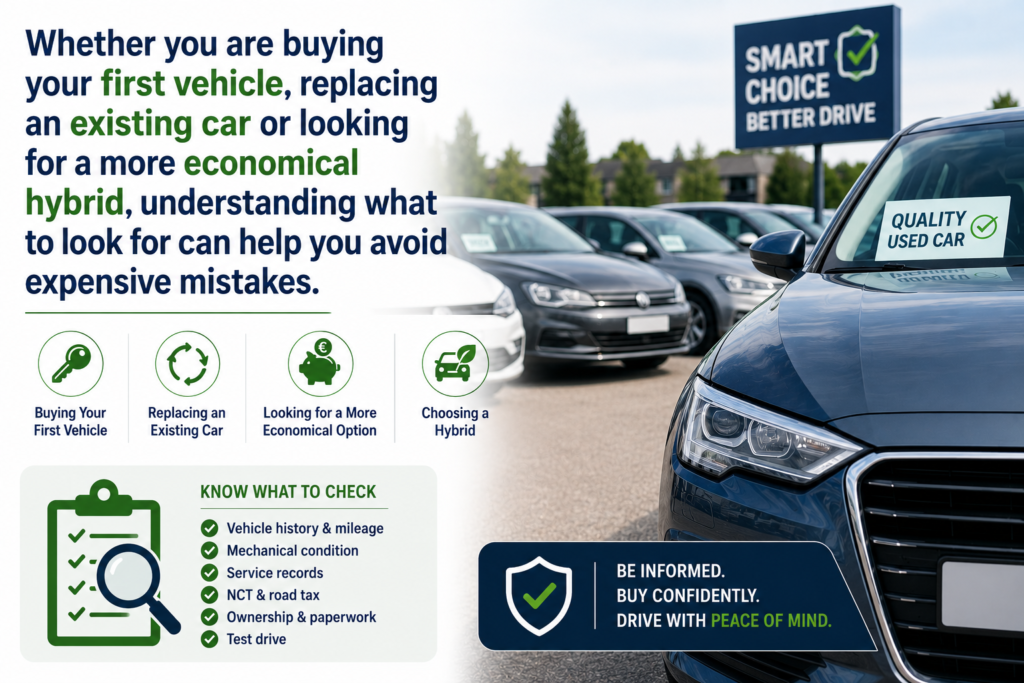
Whether you are buying your first vehicle, replacing an existing car or looking for a more economical hybrid, understanding what to look for can help you avoid expensive mistakes.
What Should You Consider When Choosing a Used Car in Ireland?
The most important factors are your budget, how you will use the car, fuel type, mileage, service history, NCT history, vehicle condition, running costs and seller reputation.
A good used car is not necessarily the cheapest one available. The right vehicle should provide a sensible balance between purchase price, reliability, practicality, fuel economy and ongoing ownership costs.
Let’s look at each factor in detail.
1. Start With Your Budget
Before searching for the best used cars Ireland, establish how much you can realistically afford. Your budget should include more than the advertised purchase price. Consider additional expenses such as:
- Insurance
- Motor tax
- Fuel
- Servicing
- Tires
- NCT-related costs
- Repairs and maintenance
- Finance repayments, if applicable For example, a vehicle with a lower purchase price may not necessarily be cheaper to own if it requires frequent repairs or has poor fuel economy.
If you are considering finance, calculate the total monthly cost of owning the vehicle rather than focusing only on the monthly repayment.
2. Choose a Car That Fits Your Lifestyle
One of the biggest mistakes when buying a second hand car is choosing a vehicle based purely on appearance or price. Think about how you actually drive.
City driving
If most of your driving takes place around Dublin or other busy urban areas, a smaller car or efficient hybrid may be practical. Compact vehicles can be easier to park and may offer lower running costs.
Long-distance driving
If you regularly travel long distances around Ireland, comfort, fuel economy, boot space and motorway performance become more important.
Family requirements
Families may need:
- More passenger space
- A larger boot
- ISOFIX points
- Good safety features
- Comfortable rear seats
Occasional driving
If you only drive occasionally, you may not need a large or expensive vehicle. A reliable, economical used car could make more financial sense.
The best car for you is ultimately the one that matches your everyday requirements.
3. Decide Between Petrol, Diesel, Hybrid or Electric
Fuel type is another important consideration.
Petrol
Petrol vehicles can be suitable for many drivers, particularly those who undertake shorter journeys and mixed driving.
Diesel
Diesel vehicles can be worth considering for drivers who regularly cover longer distances, although your individual driving pattern should determine whether diesel is appropriate.
Hybrid
Hybrid vehicles are increasingly popular among Irish drivers looking for a combination of efficiency and convenience.
Self-charging hybrids can be particularly attractive for drivers who experience a mixture of urban and longer-distance driving.
Electric
Electric vehicles can make sense for drivers who have suitable charging arrangements and driving patterns.
Before choosing an electric vehicle, consider charging availability, typical journey distances and your ability to charge at home or at convenient public locations.
4. Check the Mileage — But Don’t Focus Only on It
Mileage is important, but it should never be the only factor used to judge a used vehicle.
A car with higher mileage and an excellent service history may be a better purchase than a lower-mileage vehicle that has been poorly maintained.
When evaluating mileage, ask:
- Is the mileage consistent with the vehicle’s age?
- Is there evidence of regular servicing?
- Does the condition match the recorded mileage?
- Are there service or maintenance records?
- Has the vehicle been used primarily for motorway or urban driving?
Think about mileage + age + condition + maintenance history, rather than mileage alone.
5. Check the NCT History
NCT history is an important part of choosing a used car in Ireland.
Review available NCT information and pay attention to:
- Previous test results
- Mileage recorded during tests
- Advisories
- Failure history
- The current NCT status
An NCT certificate should not be treated as a complete mechanical inspection, however. A car can have a valid NCT and still require maintenance or repairs.
For this reason, NCT history should be considered alongside service records and the vehicle’s overall condition.
6. Ask About Service History
A properly maintained vehicle can provide considerably more confidence to a used-car buyer.
Ask whether the car has:
- Regular service records
- Receipts for maintenance
- Evidence of oil changes
- Brake maintenance records
- Tyre replacement records
- Manufacturer or specialist servicing history
A consistent service history can tell you much more about how a vehicle has been cared for than the odometer alone.
If a seller cannot provide any meaningful information about the vehicle’s maintenance, you should investigate the car more carefully before purchasing.
7. Inspect the Exterior Carefully
When viewing a used vehicle, take your time.
Look for:
- Differences in paint colour
- Scratches and dents
- Signs of previous body repairs
- Uneven panel gaps
- Rust or corrosion
- Damaged lights
- Windscreen damage
- Tyre condition
Inspect the vehicle in good daylight if possible.
Also check whether all doors, windows, lights, mirrors and other exterior equipment operate correctly.
8. Check the Interior
The interior can provide useful clues about how a vehicle has been treated.
Check:
- Seats
- Dashboard
- Steering wheel
- Pedals
- Air conditioning
- Heating
- Infotainment system
- Electric windows
- Central locking
- Parking sensors
- Reversing camera
- Warning lights
Excessive wear on the steering wheel, pedals or driver’s seat may deserve further investigation if it appears inconsistent with the stated mileage.
9. Take a Proper Test Drive
Never choose a used car without understanding how it drives. During the test drive, pay attention to:
- Engine starting
- Gear changes
- Steering
- Braking
- Suspension
- Unusual noises
- Vibrations
- Warning lights
- Acceleration
- Clutch operation on manual vehicles
Try different driving conditions where possible. Listen for unusual sounds and make sure the vehicle feels stable and comfortable.
For an automatic or hybrid vehicle, pay particular attention to how smoothly the transmission or hybrid system operates.
10. Consider Reliability and Running Costs
A reliable used car should not only be dependable; it should also be affordable to operate.
Before purchasing, research:
- Typical fuel consumption
- Insurance costs
- Motor tax
- Servicing requirements
- Tyre costs
- Common maintenance requirements
- Availability and cost of replacement parts
This is particularly important when comparing different vehicle classes.
A slightly more expensive car may provide better long-term value if it has lower running costs and a stronger maintenance record.
11. Consider the Vehicle’s History
Before committing to a purchase, investigate the vehicle’s background as thoroughly as possible.
Depending on the vehicle, you may want to establish:
- Previous ownership information
- NCT history
- Mileage history
- Service history
- Accident or damage history
- Import history
- Outstanding finance status
This is particularly relevant when considering Japanese imports or other imported vehicles. Don’t be afraid to ask the seller questions if something about the vehicle’s history is unclear.
12. Think About Resale Value
You may not plan to sell the car for several years, but resale value is still worth considering.
Vehicles with:
- Strong demand
- Good reliability reputations
- Reasonable running costs
- Complete service histories
- Desirable specifications
may be easier to sell in the future.
Popular hybrid models, economical hatchbacks and practical family vehicles can be attractive options depending on market conditions.
Buying From a Dealer vs a Private Seller
When buying a second hand car, you will generally encounter both dealerships and private sellers.
A reputable used-car dealer can provide a more structured buying experience, particularly where vehicles have been prepared, inspected and supported with appropriate documentation and warranty arrangements.
Private sales can sometimes offer attractive prices, but buyers should carry out appropriate checks and understand exactly what they are purchasing.
Regardless of where you buy, don’t let pressure or urgency prevent you from carrying out reasonable checks.
How to Choose the Best Used Car for Your Needs
A simple way to narrow down your options is to create a shortlist.
Ask yourself:
1. What is my total budget?
Include ownership costs, not just the purchase price.
2. How many kilometres do I drive?
Your annual mileage can influence your choice of fuel type.
3. Where do I drive?
City, motorway and rural driving can have different requirements.
4. How many passengers do I normally carry?
Choose a vehicle with enough space for your regular needs.
5. What features are essential?
Examples include automatic transmission, parking camera, cruise control, heated seats or navigation.
6. How much can I afford to spend on running costs?
Fuel, insurance, tax and maintenance all matter.
Once you answer these questions, you can reduce the number of vehicles you need to consider.
Why Choose Prime Motors for Your Next Used Car?
Choosing the right vehicle is about finding the right combination of price, condition, history, specification and suitability.
At Prime Motors Ltd, customers looking for used cars in Ireland can explore available vehicles and compare options according to their individual requirements.
Whether you are searching for a practical hatchback, economical hybrid, family vehicle or automatic car, take the time to understand the vehicle before making your decision.
The right used car should fit your lifestyle today while also providing sensible running costs and dependable ownership in the years ahead.
Final Used Car Buying Checklist
Before purchasing a used car in Ireland, make sure you have considered:
Your total budget
Insurance and motor tax
Fuel type
Mileage
NCT history
Service history
Vehicle history
Exterior condition
Interior condition
Tyres and brakes
Safety features
Test-drive performance
Running costs
Warranty and after-sales support
Seller/dealer reputation
Frequently Asked Questions
What should I check first when buying a used car in Ireland?
Start with your budget and driving requirements, then check the vehicle’s history, mileage, NCT status, service records and overall condition.
Is mileage important when buying a used car?
Yes, but mileage should be considered alongside age, service history, condition and how the vehicle has been used.
Should I check the NCT history before buying?
Yes. NCT history can provide useful information about previous test results, mileage and advisories, although it should not replace a full assessment of the vehicle.
Are hybrid cars a good choice in Ireland?
They can be an excellent choice for drivers seeking fuel efficiency, particularly when their driving pattern suits hybrid technology.
Is it better to buy a used car from a dealer?
A reputable dealer can offer advantages such as vehicle preparation, documentation, warranty arrangements and customer support. Buyers should still carry out appropriate checks and ask questions before purchasing.
What is the most important thing when choosing a used car?
The most important factor is finding a vehicle that matches your budget, driving needs and expected running costs while having a satisfactory history and condition.
Conclusion
Choosing the right used car in Ireland doesn’t have to be complicated. By looking beyond the advertised price and considering mileage, NCT history, service records, fuel type, reliability, running costs and vehicle condition, you can make a much more informed decision.
Use this used car buying guide Ireland as a checklist when comparing vehicles, take your time during the inspection and test drive, and don’t hesitate to ask questions before committing to a purchase.
If you’re searching for reliable used cars in Ireland, explore the latest vehicles available from Prime Motors Ltd and find a car that fits your budget, lifestyle and driving needs.