
Buying a used car in Ireland involves more than checking the bodywork, taking it for a test drive and negotiating the price. One of the most important checks you can make is the vehicle’s NCT history.
The National Car Testing (NCT) record can provide useful information about a car’s previous test results, mileage readings, test dates and items that needed attention. Reviewing this information before buying can help you identify potential warning signs and ask the seller better questions. If you are considering a used car in Ireland, here’s how to check NCT history, what the results mean and what you should look for before making a purchase.
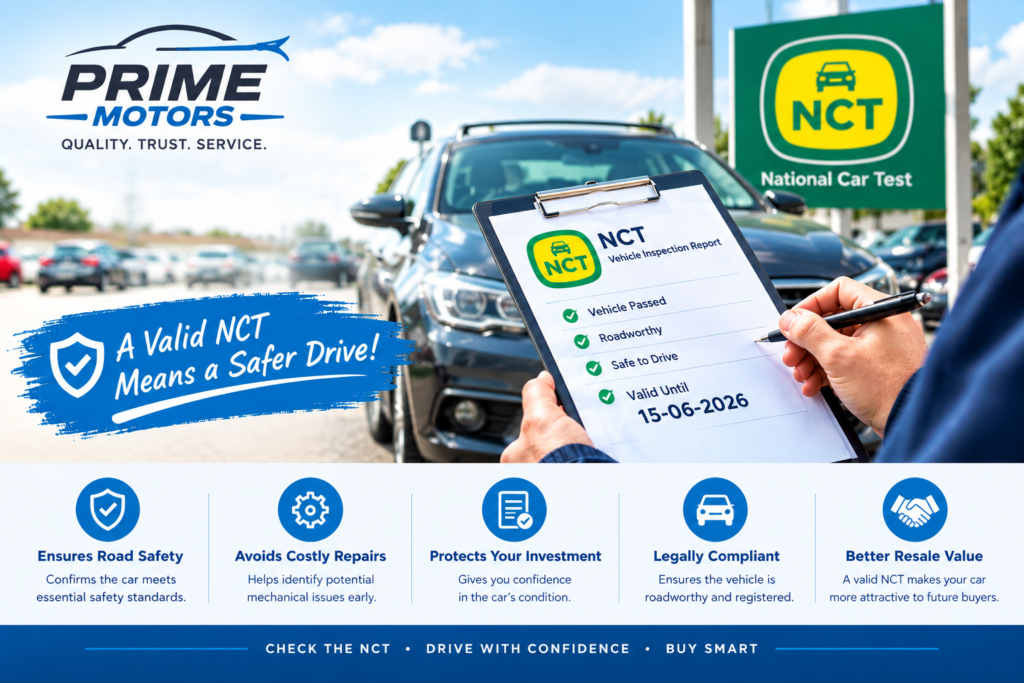
What Is NCT History?
The NCT is Ireland’s National Car Testing service for vehicles. Cars are tested to assess their roadworthiness and compliance with required safety and environmental standards.
An NCT history is the record of previous NCT tests associated with a vehicle. Depending on the vehicle’s testing history, you may be able to see information such as:
- Previous NCT test dates
- Test results
- Recorded mileage
- Advisories or items requiring attention
- The vehicle’s next NCT due date
For someone buying a used car, this information can provide useful background that may not be obvious from looking at the vehicle.
How to Check NCT History in Ireland
Before buying a used car, you can use the official NCT online service to check information associated with the vehicle. You will generally need the vehicle’s registration number to search for its NCT information.
Step 1: Get the Registration Number
Ask the seller for the car’s registration number. Make sure the registration number you search matches the vehicle you are viewing. Do not rely solely on screenshots or information supplied by the seller. Where possible, check the details yourself.
Step 2: Access the NCT History Service
Use the official NCT website and its vehicle history facility to search for the car’s previous NCT information. Enter the registration details requested by the service and review the available records.
Step 3: Review Previous Test Results
Look through the vehicle’s previous tests rather than concentrating only on its most recent NCT. A car that currently has a valid NCT may still have a history of repeated failures or recurring advisories.
Step 4: Compare the Mileage
Pay particular attention to the mileage recorded at different NCT tests. The mileage should generally increase as the vehicle gets older. A significant unexplained decrease between recorded readings deserves further investigation.
What Do NCT Results Mean?
Understanding the terminology used in NCT records is important when evaluating a used car.
Pass
A pass means the vehicle met the required standards at that particular test. However, a current NCT pass does not necessarily mean the vehicle is mechanically perfect. An NCT is a roadworthiness test rather than a complete mechanical inspection or guarantee of future reliability.
Fail
A failed NCT means the vehicle did not meet one or more requirements at the time of testing. If you see previous failures in the history, look at what caused them and whether the vehicle subsequently passed. A previous failure isn’t automatically a reason to reject a car. More important questions include:
- What did it fail on?
- Was the issue repaired?
- How many times did it fail?
- Did the vehicle pass shortly afterwards?
Advisories
Advisories can be particularly useful when researching a used car. An advisory identifies an item that the tester has brought to the vehicle owner’s attention but which did not necessarily result in a failure at that test. Repeated advisories for the same component can be worth investigating. For example, if similar issues appear repeatedly across several tests, ask the seller whether the relevant component has since been repaired or replaced.
Why Mileage Is Important
Mileage is one of the most useful pieces of information to examine when checking NCT history for a used car. Because mileage is recorded during NCT testing, historical readings can help you establish a timeline for the vehicle. Ideally, you should see a logical progression such as:
Previous NCT → higher mileage → next NCT → higher mileage again
A lower mileage reading at a later test does not automatically prove that a car’s odometer has been tampered with. There can be legitimate explanations, including recording or data-entry errors. However, a substantial unexplained discrepancy should be treated as a warning sign and investigated before purchasing. You should also compare the NCT mileage with other available records, such as service documentation, invoices and maintenance records.
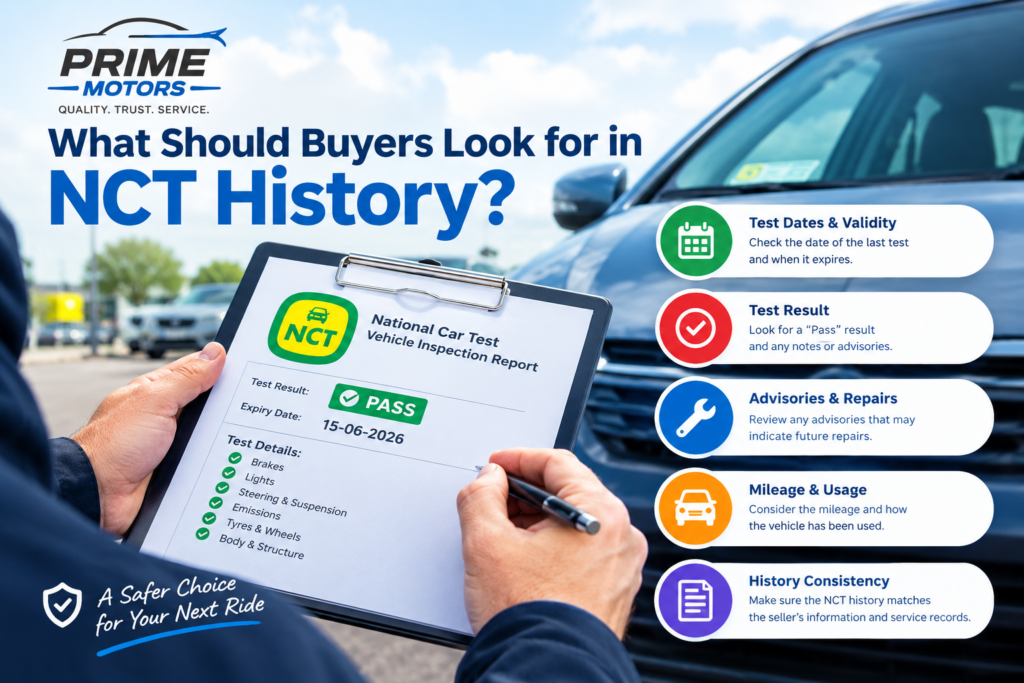
What Should Buyers Look for in NCT History?
When reviewing a used car’s NCT record, don’t simply look for the word “Pass.” Examine the history as a whole.
1. Repeated NCT Failures
Several failures may indicate that the vehicle has had recurring roadworthiness problems. Look at the reasons for those failures rather than simply counting them.
2. Recurring Advisories
Repeated advisories involving the same area of the vehicle can indicate an issue that has been present for some time.
Ask the seller whether the issue was eventually addressed.
3. Mileage Inconsistencies
Check whether the recorded mileage follows a sensible progression.
If you notice an unexplained decrease, ask for supporting documentation.
4. Recent Test History
A recently passed NCT can be useful, but remember that the test only reflects the vehicle’s condition at the time it was tested. A used car should still be inspected carefully before purchase. The biggest advantage of checking NCT history is that it allows you to look for patterns. One isolated advisory may not tell you much. Several similar advisories or failures over multiple tests may provide much more useful information.
Don’t Rely on NCT History Alone
NCT history is an important part of researching a used car, but it should not be your only check. Before buying, consider carrying out additional checks, including:
- Inspecting the vehicle’s service history
- Checking maintenance and repair invoices
- Comparing the mileage with available documentation
- Checking the vehicle identification details
- Taking the car for a thorough test drive
- Inspecting the tyres, brakes, lights and bodywork
- Checking for signs of accident damage
- Having an independent mechanic inspect the vehicle
You should also make sure that the seller’s description matches the vehicle and its documentation.
What If the Seller Says the Car Has a “Full NCT”?
Be careful about treating a valid NCT as a guarantee that the car is in excellent condition. The NCT is designed to assess roadworthiness according to specific testing requirements. It does not replace a comprehensive pre-purchase mechanical inspection.
A car can have a valid NCT while still requiring maintenance or having mechanical problems that aren’t part of the NCT’s testing scope. For this reason, think of the NCT record as one part of your used-car research, rather than the entire inspection process.
A Simple NCT History Checklist
Before buying a used car, use this quick checklist:
- ✓ Search the vehicle’s NCT history using its registration number.
- ✓ Review previous test dates and results.
- ✓ Check recorded mileage at each available test.
- ✓ Look for unexplained mileage discrepancies.
- ✓ Review previous failures and their reasons.
- ✓ Look for recurring advisories.
- ✓ Ask the seller about significant or repeated issues.
- ✓ Compare NCT mileage with service and maintenance records.
- ✓ Arrange an independent inspection if you are seriously considering the vehicle.
- ✓ Don’t assume a valid NCT means the car is mechanically perfect.
Frequently Asked Questions About Checking NCT History
How can I check the NCT history of a used car?
You can use the official NCT vehicle history service and search using the vehicle’s registration details. Review the available test results, mileage and other historical information.
What should I look for in an NCT history?
Look for previous failures, recurring advisories, mileage readings and patterns across multiple tests. These details can help you identify questions that should be answered before buying.
Does an NCT pass mean the car is in good condition?
An NCT pass means the vehicle met the applicable requirements at that particular test. It should not be considered a complete mechanical inspection or guarantee of future reliability.
Is NCT mileage useful when buying a used car?
Yes. Historical NCT mileage readings can help you establish whether the vehicle’s recorded mileage follows a logical progression. Any significant unexplained discrepancy should be investigated.
Should I buy a car that previously failed its NCT?
A previous failure does not necessarily mean the vehicle is unsuitable. Check the reason for the failure, whether the issue was repaired and whether the vehicle subsequently passed.
Final Thoughts
Checking the NCT history of a used car is a simple but valuable step before buying a vehicle in Ireland. Previous test results, advisories and mileage readings can help you understand the car’s history and identify questions that should be answered before you commit to a purchase.
The most important thing is to look beyond the latest NCT result. Review the vehicle’s history over time and look for patterns, particularly repeated failures, recurring advisories or unusual mileage readings.
For the best protection when buying a used car, combine the NCT history with service records, a physical inspection, a test drive and, where appropriate, an independent mechanic’s assessment.
Doing these checks before handing over your money can give you a much clearer picture of the vehicle you are considering and help you make a more informed used-car purchase.